
Family Expense Tracking: How to Manage Shared Finances Without the Admin Burden
Managing family spending doesn't require endless spreadsheets or constant disagreement. Learn how to structure shared categories, divide costs fairly, capture cash purchases instantly, and maintain personal financial autonomy.

Coordinating shared spending across a household shouldn't feel like managing a full-time corporate auditing team. Yet for many families and couples, tracking day-to-day expenditures creates constant friction. One partner often carries the burden of manual record-keeping while the other feels out of the loop, or small cash purchases simply vanish without a trace, leaving unexplained gaps in the budget at the end of the month.
The secret to sustainable family expense tracking isn't logging every single coffee or micro-transaction into an overly complex system. Instead, it relies on establishing clear categories, choosing an equitable funding model, adopting low-friction logging habits, and protecting each person's individual spending autonomy. This guide covers practical frameworks to manage family finances effectively without spending hours on administrative work.
The Three-Bucket Framework for Shared Expenses
Before choosing tools or logging daily purchases, sit down together to classify how money moves through your household. Trying to track every transaction under one giant pool creates confusion. Dividing spending into three distinct buckets creates clarity and immediate alignment.

1. Fixed Shared Costs
Fixed shared costs are non-negotiable, recurring monthly expenses required to keep the household running. Because these amounts remain predictable, they require minimal active oversight once calculated.
- Housing: Rent or mortgage payments, property taxes, and home insurance.
- Utilities & Services: Electricity, water, gas, home internet, and trash collection.
- Recurring Commitments: Childcare fees, school tuition, vehicle insurance, and joint family subscriptions.
2. Variable Household Expenses
Variable shared expenses represent day-to-day operational costs that fluctuate based on household needs and daily consumption patterns. This bucket requires regular tracking to keep totals within target ranges.
- Groceries & Supplies: Food items, household cleaning products, and toiletries.
- Transport: Shared vehicle fuel, public transit passes, parking, and routine vehicle upkeep.
- Joint Leisure: Family dining out, weekend outings, movies, and shared holiday savings.
3. Personal Discretionary Allowances
Personal discretionary allowances (often referred to as 'fun money') are individual funds allocated to each household member. This money can be spent on anything without justification, approval, or itemized tracking by the rest of the family.
- Personal hobbies, gaming, or specialized tech gear.
- Individual apparel, shoes, and personal care.
- Solo dining, coffee runs, or gifts for friends.
Establishing Upfront Rules for Grey Areas
Disagreements often arise around ambiguous costs that straddle personal and shared boundaries. For instance, is an afternoon coffee run a shared variable expense or personal spending? Does buying a brand-new kitchen appliance fall under home supplies or personal hobbies? Agreeing on clear rules beforehand prevents micro-arguments during weekly budget checks.
Selecting a Fair Expense Contribution Model
How a household funds its shared buckets depends on earning balance, financial goals, and personal preferences. Three primary contribution models work best for modern families.
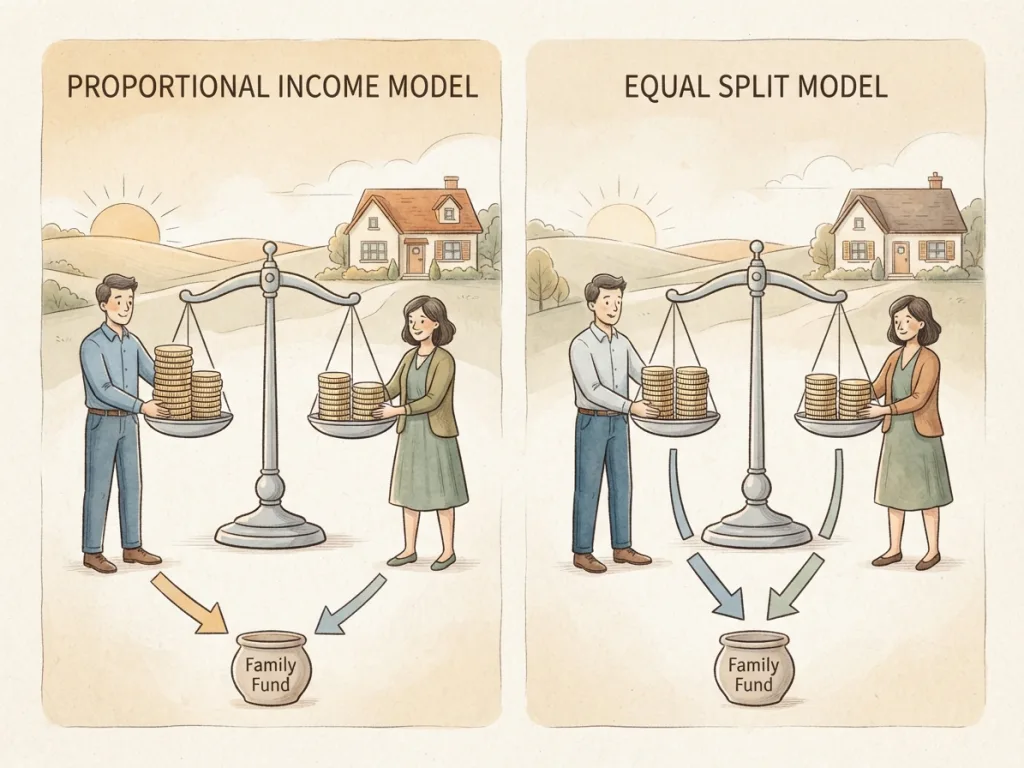
| Contribution Model | How It Works | Best Fit For | Key Advantage |
|---|---|---|---|
| Equal Split (50/50) | Both partners contribute exact equal dollar amounts to fixed and variable buckets. | Couples with similar net incomes and comparable financial liabilities. | Simple to calculate and maintain. |
| Proportional Split | Contributions are calculated as a percentage of total household income. | Households with significant income differences between partners. | Ensures relative financial equity and shared strain. |
| Dedicated Household Fund (Hybrid) | All income funds shared buckets first; remaining funds become equal personal allowances. | Married couples or families with fully unified long-term financial goals. | Maximizes progress on joint savings and household targets. |
Regardless of the mathematical model you choose, keeping shared operational funds distinct from personal discretionary spending is essential for long-term harmony.
Capturing Cash Purchases and Physical Receipts Instantly
One of the main reasons household tracking systems fail is the 'receipt black hole.' Paper receipts from local grocery markets, hardware stores, or cash outlays get shoved into pockets or forgotten, leaving balance discrepancies at the end of the month.
Eliminating the End-of-Month Receipt Black Hole
Trying to remember every cash outlay or paper receipt during an end-of-month reconciliation is impossible. Human memory degrades quickly, leading to missing data and frustration. Cash purchases and physical receipts must be captured at the point of sale, immediately after the transaction occurs.
Using Low-Friction Input Workflows
Logging purchases should take seconds, not minutes. Utilizing modern multi-input workflows dramatically lowers the effort required to keep records current: