
How Much Should I Save Each Month? A Realistic Framework for Any Income
Learn how much to save each month using flexible percentage frameworks, prioritised emergency buffers, and practical strategies tailored to your income level.

Determining how much money to save per month is one of the most common challenges in personal finance. Whether you are earning your first steady paycheck, managing a household budget, or juggling fluctuating freelance payments, setting an arbitrary savings target can quickly lead to frustration. If your target is too aggressive, you risk falling short and giving up; if it is too lax, you may lose ground on your long-term goals.
The key to building a realistic monthly savings habit lies in choosing a flexible framework rather than a rigid formula. This guide breaks down standard savings percentage rules, explains how to prioritise your cash reserve, and shows you how to calculate a sustainable baseline tailored to your unique financial situation.
Disclaimer: This article provides general educational information on personal budgeting principles and does not constitute individualized financial, investment, or legal advice.
Understanding the Baselines: Percentage Frameworks Explained
Financial guidelines often rely on percentage-based frameworks because they automatically adjust to your income. Rather than focusing on a fixed dollar amount, percentages allow you to scale your target as your financial situation evolves.

The 50/30/20 Framework
Popularised by personal finance experts, the 50/30/20 rule serves as a helpful baseline for structuring your monthly net (take-home) income:
- 50% for Needs: Essential expenses required for basic living, including rent or mortgage, basic utilities, transportation, minimum debt obligations, groceries, and essential healthcare.
- 30% for Wants: Discretionary spending that enhances your lifestyle, such as dining out, subscriptions, hobbies, entertainment, and vacations.
- 20% for Savings & Extra Debt Payoff: Money directed toward emergency funds, retirement contributions, long-term investments, or debt payments beyond the required minimums.
Modifying Percentages for High-Cost Cities or Tight Budgets
While 20% is a great benchmark, it is not always feasible. If you live in a High-Cost-of-Living (HCOL) area where housing costs swallow a large share of your paycheck, forcing a strict 20% savings rate can cause unnecessary financial stress.
In such scenarios, a modified ratio like 60/25/15 (60% Needs, 25% Wants, 15% Savings) or 65/25/10 provides a far more practical starting point. Remember that saving 5% or 10% consistently is significantly better than aiming for 20%, hitting a deficit, and abandoning your plan entirely.
The Order of Financial Priorities: Where Your Savings Should Go
Knowing how much to save per month is only half the equation; you also need to know where to allocate those funds. Following an intentional priority framework ensures every saved dollar works effectively.
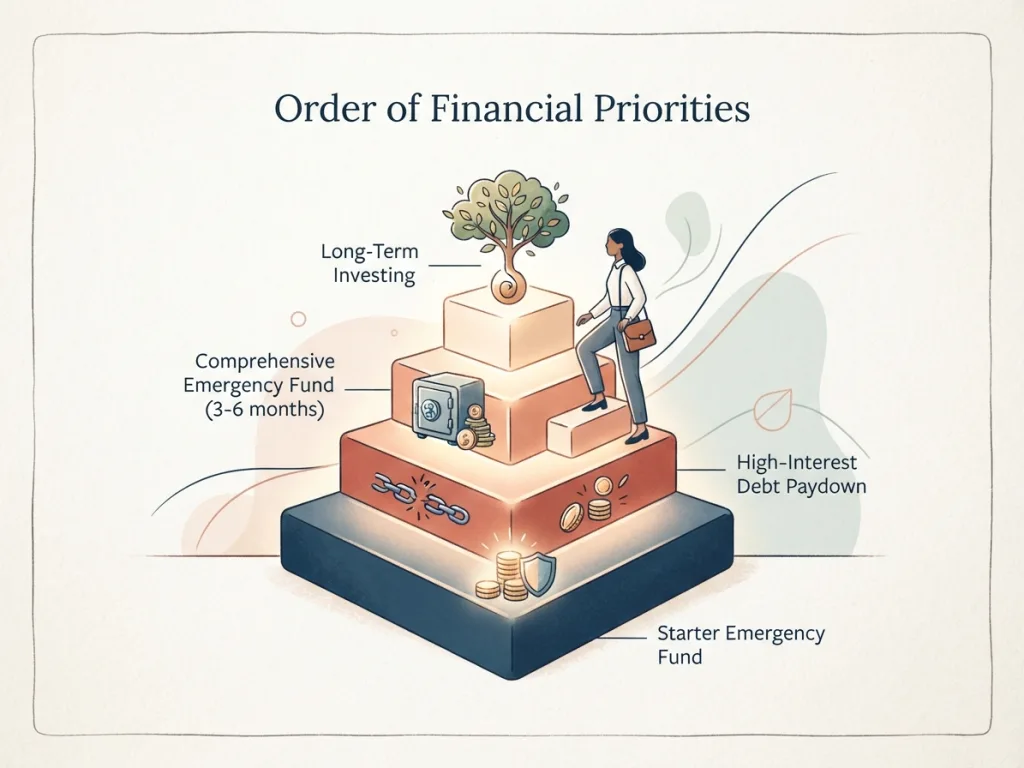
| Priority Level | Savings Focus | Primary Objective |
|---|---|---|
| Level 1 | Starter Emergency Fund | Cover minor cash shocks (e.g., $500–$1,000 equivalent buffer) |
| Level 2 | High-Interest Debt Payoff | Eliminate high-cost consumer debt (e.g., credit card balances) |
| Level 3 | Full Emergency Reserve | Accumulate 3 to 6 months of essential living expenses |
| Level 4 | Long-Term Investments & Goals | Fund retirement, property down payments, or major life goals |
Level 1: The Starter Emergency Buffer
Before aggressive long-term investing, build a small emergency cushion. Having even a modest buffer prevents you from relying on high-interest credit cards when minor unexpected costs arise, such as an urgent medical visit or household repair.
Level 2: High-Interest Debt vs. Saving
If you carry high-interest debt, paying down balances above the required minimum often yields a higher financial return than traditional savings accounts. Once your starter emergency fund is secure, divert surplus monthly savings toward high-interest debt to reduce long-term interest burdens.
Level 3: Full Emergency Reserve
Official guidelines from major financial bodies recommend maintaining 3 to 6 months' worth of essential living expenses in liquid, easily accessible accounts. This reserve protects you against significant shocks, such as unexpected job loss or income interruption.
Level 4: Long-Term Goals and Wealth Building
Once your emergency reserve is fully funded, redirect your monthly savings allocation into retirement accounts, general investment portfolios, or earmarked accounts for major milestones like buying a home or funding education.
Tailoring Savings Targets to Your Life Situation
Fixed Paycheck Earners: Pay Yourself First
If you earn a predictable salary, the most effective habit is the "Pay Yourself First" strategy. Instead of waiting until the end of the month to save whatever is left over, schedule an automated transfer to your savings account on payday. Treating your savings like a non-negotiable bill ensures consistent progress.
Variable and Freelance Earners: The Baseline Buffer Strategy
Freelancers, commission-based workers, and gig economy contractors face unpredictable monthly income. Rather than relying on a static monthly percentage target, calculate your baseline monthly essential expenses. During high-earning months, deposit surplus earnings into an income buffer account. During lean months, draw from this reserve to cover essential needs without disrupting your financial momentum.
How to Calculate Your Personal Monthly Savings Target
You can establish a practical, personalized savings benchmark in three simple steps:
- Step 1: Determine Net Take-Home Income. Calculate your monthly income after taxes and mandatory withholdings. Avoid using gross earnings, as taxes will skew your calculations.
- Step 2: Isolate Unavoidable Essential Expenses. Sum up mandatory expenses (rent, utilities, basic groceries, minimum loan repayments). Subtract this total from your net income to find your available cash surplus.
- Step 3: Measure Surplus Cash Flow. Divide your remaining cash between discretionary spending and savings. Decide on an initial savings percentage (e.g., 10% or 20% of net income) that feels comfortable based on your actual margin.
Building a Sustainable Habit Without Burnout
The Micro-Saving Strategy
If reaching a 10% or 20% target feels overwhelming, start small. Micro-saving involves setting aside small, manageable amounts—such as 1% to 5% of your net income—and increasing the rate by 1% every few months. Consumer finance studies demonstrate that building consistent saving behavior early creates lasting financial resilience, regardless of starting size.
Tracking Expenses to Stay On Target
Maintaining a realistic savings habit requires total visibility over where your money actually goes. Unconscious discretionary spending can easily erode your planned savings margin.
Tools like MyMoney help you maintain total clarity over your cash flow without tedious administrative work. By organizing transactions into clear Needs vs. Wants categories, MyMoney lets you quickly review monthly spending trends and spot opportunities to expand your savings margin.
With convenient capture options like AI Quick Entry—which drafts transaction details from quick text or voice inputs for your review—and the AI Receipt Scanner for instant expense logging, capturing accurate spending data takes only seconds. Designed with an offline-first architecture, MyMoney ensures your personal financial records stay accessible and synced whenever you need them.
Frequently Asked Questions
How much emergency fund should I build per month?
Focus on contributing a realistic amount—such as 5% to 15% of your take-home pay—toward your emergency reserve until you accumulate between 3 and 6 months of essential living expenses.
What if my fixed expenses take up more than 50% of my income?
If essential needs exceed 50%, adjust your ratio to fit your reality (e.g., 60/25/15). Focus on building a small starter buffer first, then look for opportunities to reduce recurring fixed costs or increase net earnings over time.
Should I save or pay off debt first?
Build a starter emergency fund first to cover unexpected expenses. After securing that safety net, focus surplus savings on high-interest consumer debt before building out a full 3- to 6-month emergency reserve.