
The 50/30/20 Budget Rule: How It Works and How to Adapt It
Discover how the 50/30/20 budget rule works, how to divide your after-tax income into needs, wants, and savings, and how to adapt the ratios for real-world expenses.

Managing personal finances can feel overwhelming when every dollar requires meticulous line-item tracking. For anyone seeking a straightforward framework, the 50/30/20 budget rule offers a flexible, macro-level method to organize spending without requiring dozens of complex spreadsheet categories. Instead of counting every penny, this system groups your monthly after-tax income into three main buckets: essential needs, flexible wants, and long-term financial goals.
While the standard percentage target serves as an intuitive benchmark, real-life expenses—such as rising rent or fluctuating earnings—mean the framework often requires adjustment. Understanding how the 50/30/20 rule works, where expenses actually belong, and when to modify the ratios allows you to build a sustainable personal cash flow plan.
What Is the 50/30/20 Budget Rule?
The 50/30/20 budget rule is a proportional budgeting framework designed to balance immediate living costs with personal spending and future security. Rather than dictating specific dollar limits for every item, it establishes broad financial boundaries based on percentages of your take-home pay.

The Core Principle
Under this strategy, your net monthly income is split into three defined categories:
- 50% for Needs: Essential living expenses required for survival and basic obligations.
- 30% for Wants: Discretionary spending that enhances your lifestyle but isn't required for daily functioning.
- 20% for Savings & Debt Repayment: Funds allocated to long-term wealth building, emergency preparation, and debt reduction beyond required minimums.
Where the Rule Came From
The framework was introduced by Senator Elizabeth Warren and her daughter Amelia Warren Tyagi in their 2005 book All Your Worth: The Ultimate Lifetime Money Plan. Designed as a practical guide for working families, the framework emphasizes long-term balance over short-term deprivation. By focusing on macro percentages, it helps individuals prevent structural overspending on fixed costs before lifestyle inflation takes over.
How to Calculate Your Baseline Income
To apply the 50/30/20 budget rule effectively, calculations must start with your after-tax income (also known as take-home pay). Applying percentages to your gross salary creates an inaccurate representation of your usable funds because taxes, mandatory payroll withholdings, and government deductions are already committed.
Why After-Tax Income Matters
Your net income is the total dollar amount deposited into your bank account after federal, state, and local taxes, Social Security, and Medicare are withheld. If you have pre-tax deductions automatically taken out—such as employer health insurance or standard retirement contributions—you can either base your budget on the final net check or add mandatory insurance back into your net baseline to review overall totals clear-headedly.
Handling Irregular or Variable Paychecks
For freelancers, gig workers, or professionals earning commission, monthly net income fluctuates. In these situations, calculate your baseline using your average net earnings over the past 3 to 6 months, or use your lowest-earning month as a conservative floor. Extra earnings during higher-income months can then be funneled directly into savings or debt repayment buckets.
Breaking Down the 50/30/20 Categories
Determining which bucket an expense belongs in is the key to managing this framework accurately. Misclassifying discretionary choices as non-negotiable living costs is one of the most common budget errors.
50% Needs: Non-Negotiable Living Costs
Needs encompass basic survival items and legal contractual obligations. If you stopped paying a need, your health, safety, shelter, or employment would be immediately compromised.
- Housing: Rent payments or primary mortgage payments (including property tax and basic home insurance).
- Utilities: Electricity, water, natural gas, heating fuel, and standard residential internet access.
- Transportation: Car payments, commuter transit passes, fuel, vehicle insurance, and mandatory maintenance.
- Basic Groceries: Essential food items purchased at grocery stores to cook at home.
- Healthcare: Insurance premiums, necessary prescriptions, and copays.
- Minimum Debt Obligations: Mandatory minimum payments on credit cards, student loans, or personal loans. (Failing to pay minimums leads to credit default and legal consequences).
30% Wants: Lifestyle and Personal Choices
Wants represent items that enhance daily comfort, entertainment, and personal preferences. You could survive without these expenses if forced to eliminate them during a financial hardship.
- Dining Out & Delivery: Restaurant meals, coffee shop visits, takeout, and specialty food purchases.
- Entertainment & Subscriptions: Streaming services, concert tickets, gym memberships, and gaming.
- Hobbies & Recreation: Sports gear, craft supplies, travel, and vacation expenses.
- Upgraded Essentials: Premium smartphone plans, designer clothing brands, or luxury vehicle upgrades above standard commuting needs.
20% Savings and Debt Repayment: Building Long-Term Security
The final 20% is dedicated to improving your future balance sheet and preparing for unexpected disruptions.
- Emergency Funds: Cash reserves stored in liquid high-yield savings accounts covering 3 to 6 months of basic living costs.
- Retirement Accounts: Individual retirement contributions (IRAs) or taxable investment portfolios.
- Debt Acceleration: Additional principal payments made toward high-interest credit cards, personal loans, or mortgages above the required minimum.
- Sinking Funds: Targeted savings for predictable future outlays, such as periodic car repairs or annual insurance policies.
Real-World Adaptations for Different Income Levels
The traditional 50/30/20 split assumes a balanced economic environment and a mid-range income. In reality, high cost of living (HCOL) cities, entry-level salaries, or aggressive savings goals require tailoring the framework to fit individual circumstances.
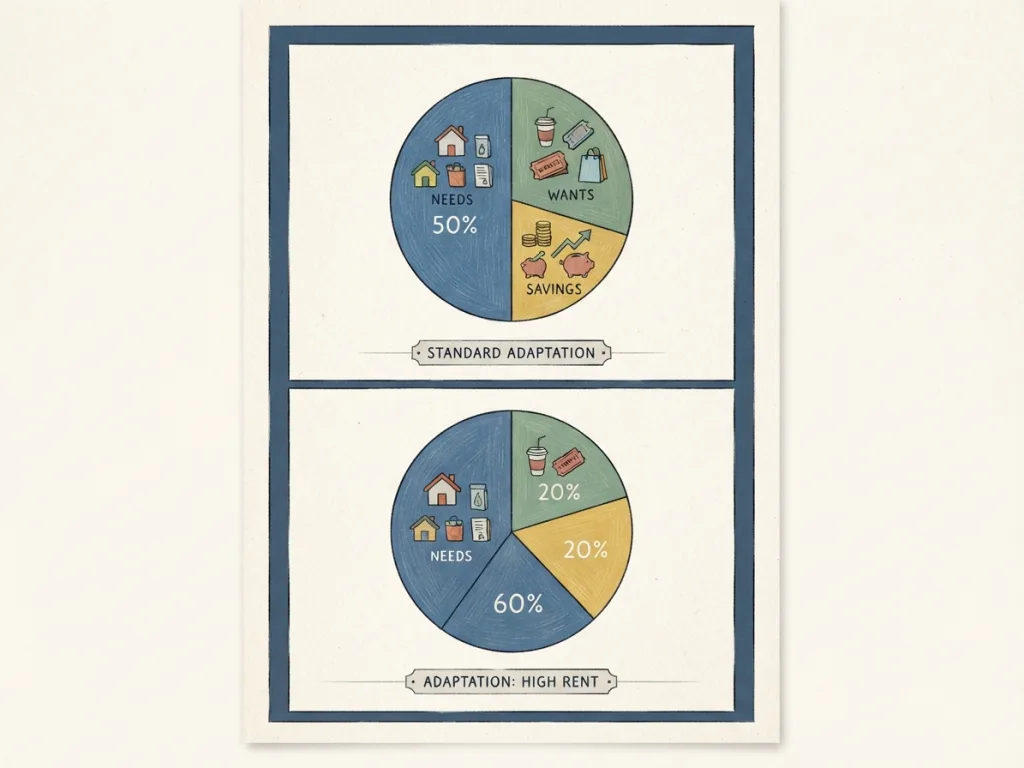
| Budgeting Model | Needs (%) | Wants (%) | Savings & Debt (%) | Best Suited For |
|---|---|---|---|---|
| Standard 50/30/20 | 50% | 30% | 20% | Average incomes in moderate cost-of-living areas |
| High Rent (60/20/20) | 60% | 20% | 20% | Residents in expensive urban rental markets |
| Tight Budget (70/20/10) | 70% | 20% | 10% | Entry-level workers or during temporary economic hardship |
| Aggressive Saver (40/20/40) | 40% | 20% | 40% | High earners or those aiming for early retirement |
The 60/20/20 Split for High Housing Costs
In high-cost housing markets, rent or mortgage payments alone can exceed 35% of take-home pay. Adjusting your framework to 60% Needs, 20% Wants, and 20% Savings allows you to cover elevated living costs without abandoning your future financial goals entirely.
The 70/20/10 Split for Tight Budgets
When starting out on an entry-level salary or managing single-income households, fixed costs naturally swallow a larger proportion of paychecks. Expanding Needs to 70% while keeping Savings at 10% ensures you remain solvent without building up high-interest debt.
The 40/20/40 Split for Accelerated Financial Goals
High earners or proponents of early financial independence often lower their relative living expenses to 40% and scale back Wants to 20%. This frees up 40% of net income to pay off mortgages quickly or build investment portfolios.
50/30/20 vs. Other Budgeting Frameworks
Selecting the right money management system depends on how much detail you prefer to track daily.
Comparing Macro-Budgeting and Zero-Based Budgeting
Zero-Based Budgeting (ZBB) requires allocating every single dollar of income to a designated expense line item before the month begins until the remaining balance equals zero. While ZBB provides high control, it can cause burnout. The 50/30/20 rule is a macro-budgeting approach that offers freedom within high-level guidelines, making it much easier to sustain over long periods.
Comparing Proportional Allocations and the Envelope System
The Envelope Method (or cash stuffing) relies on strict physical or digital containers holding exact dollar caps for specific categories like groceries or fuel. Once an envelope is empty, spending stops immediately. The 50/30/20 framework focuses on overall financial proportions rather than physical cash caps, making it ideal for electronic payment methods and card usage.
Common Mistakes to Avoid
Even simple budgeting systems require clear rules to stay effective. Avoid these subtle pitfalls when setting up your percentages.
Confusing Gross and Net Income
Calculating 50% based on pre-tax earnings inflates what you can afford for shelter or car loans. Always perform calculations strictly on your actual post-tax deposit amounts.
Labeling Upgraded Lifestyle Choices as Needs
While food is a basic need, food delivery, daily lattes, and specialty organic markets are discretionary wants. Differentiate between baseline function and convenience choices when categorizing monthly spending.
Misallocating Debt Payments
A frequent error is placing all debt payments inside the 20% savings bucket. Minimum required payments must be categorized under 50% Needs because neglecting them causes interest penalties and credit score damage. Only extra principal payments beyond the minimum belong in the 20% bucket.
Giving Up Due to Manual Tracking Fatigue
Manually recording transactions into paper journals or complex spreadsheets frequently leads to tracking fatigue. When logging spending becomes burdensome, people tend to stop tracking altogether, missing key budget trends.
How to Track Your 50/30/20 Split Effortlessly
Maintaining a budget shouldn't require spending hours every weekend reconciling receipts. Using tools designed to simplify transaction logging keeps you aligned with your targets effortlessly.
Setting Up Flexible Category Thresholds
Modern personal finance applications allow you to group individual expenses under broader umbrella buckets. By creating custom spending tags or macro categories for Needs, Wants, and Savings, you can instantly see whether your monthly spending aligns with your intended percentages.
Reducing Daily Logging Friction with Smart Tools
To keep expense tracking effortless, specialized apps help streamline transaction entry without tedious manual typing:
- Natural Language Entry: Solutions like MyMoney offer AI Quick Entry, allowing you to type or dictate natural phrases such as "$45 for groceries at supermarket" to automatically draft categorized entries for quick user review and confirmation.
- Receipt Scanning: Instead of manually entering multi-item receipts, the AI Receipt Scanner extracts transaction details into an editable review flow, allowing you to verify category assignments instantly.
- Offline-First Synchronization: Reliable apps support offline-first tracking, keeping your ledger accessible without relying on constant cellular connectivity, while syncing securely when you reconnect.
Note: AI financial tracking features serve as helpful draft assistance for user review and confirmation, not as automated financial advice.
Frequently Asked Questions
What if my fixed needs exceed 50% of my income?
If your essential costs cross the 50% mark due to high housing or utility costs, temporarily adjust your budget to a 60/20/20 or 65/20/15 split. Focus on trimming discretionary wants before reducing your long-term savings contributions.
Where do utility bills and internet access belong?
Standard utility bills (water, gas, electricity) and basic home internet belong in the 50% Needs category. However, upgraded premium cable packages or ultra-high-speed gaming tiers should be categorized as 30% Wants.
Does the 20% bucket include employee 401(k) contributions?
Yes. If retirement contributions are deducted directly from your paycheck before landing in your bank account, you can count those contributions toward your 20% savings goal. Ensure you adjust your baseline net income calculation accordingly to reflect pre-tax savings accurately.
Building a Personal System That Lasts
The 50/30/20 budget rule is not a rigid financial formula—it is a practical baseline created to give your money direction. By separating non-negotiable living expenses from discretionary lifestyle choices and long-term goals, you establish clear limits that adapt to changing circumstances over time.
Success in personal finance comes from consistency rather than perfection. Choose baseline targets that fit your current environment, eliminate friction with tools like MyMoney, and review your proportions periodically to stay aligned with your long-term financial priorities.