
How to Budget with Irregular Income: A Step-by-Step Guide for Freelancers
Managing variable monthly income doesn't mean guessing your budget. Learn how to smooth cash flow, set aside taxes upfront, and pay yourself a steady salary.

When your income changes every month, traditional financial advice often feels completely unworkable. Standard budgeting strategies usually assume you receive a predictable paycheck on the 1st and 15th of every month. But if you work as a freelancer, gig contractor, project-based consultant, or commission salesperson, your bank account balance looks more like a roller coaster than a steady line.
This unpredictable cash flow frequently triggers a destructive feast-or-famine cycle. During high-income months, it is easy to overspend because accounts look flush. When a slow month hits, covering basic bills like rent, debt minimums, or tax obligations suddenly causes immense anxiety. The secret to learning how to budget with irregular income is not predicting what you will earn next month—it is building a dynamic priority system that manages the money you have right now while smoothing out monthly peaks and valleys.
The Irregular Income Challenge: Why Traditional Budgets Fail
Traditional fixed budgets start with a set revenue number at the top of a spreadsheet and distribute that exact sum across spending categories. When your monthly earnings fluctuate wildly, this approach breaks down quickly for two reasons:

- Timing mismatches: You might incur fixed monthly commitments like rent or software subscriptions on the 1st, but your client invoices might not clear until the 25th.
- False optimism: Planning spending around your average earnings leaves you vulnerable whenever income drops below that average for two consecutive months.
To establish financial stability without a regular paycheck, you must shift your perspective: budget your cash flow based on expense priorities rather than optimistic income forecasts.
Step 1: Calculate Your Baseline Income Floor and Bare-Bones Budget
Before deciding how much money you can spend on discretionary lifestyle choices, you need to establish your absolute minimum financial requirements.
Finding Your Income Floor
Look back over your total earnings from the past 6 to 12 months. Identify the single lowest-earning month in that period. Alternatively, calculate the average of your three lowest months. This figure represents your Baseline Income Floor. Building your routine budget around this conservative floor ensures that your basic living needs remain covered even during your slowest business cycles.
Defining Essential Survival Expenses
Next, assemble a bare-bones survival budget. This consists strictly of mandatory expenses required to keep your household functioning and compliant:
- Housing: Rent or mortgage payments.
- Utilities & Essentials: Electricity, water, internet, basic mobile service, and essential groceries.
- Critical Commitments: Health insurance premiums and baseline debt payments.
- Work Continuity Costs: Core software subscriptions or transport needed to continue generating income.
Subtracting your bare-bones baseline expenses from your income floor tells you exactly how much breathing room your business model naturally provides during lean periods.
Step 2: Build an Income Holding Account to Pay Yourself a Fixed Salary
The single most effective way to eliminate cash flow anxiety is to separate the money your client contracts bring in from the money you spend daily. You can accomplish this by establishing an Income Holding (or Buffer) Account.
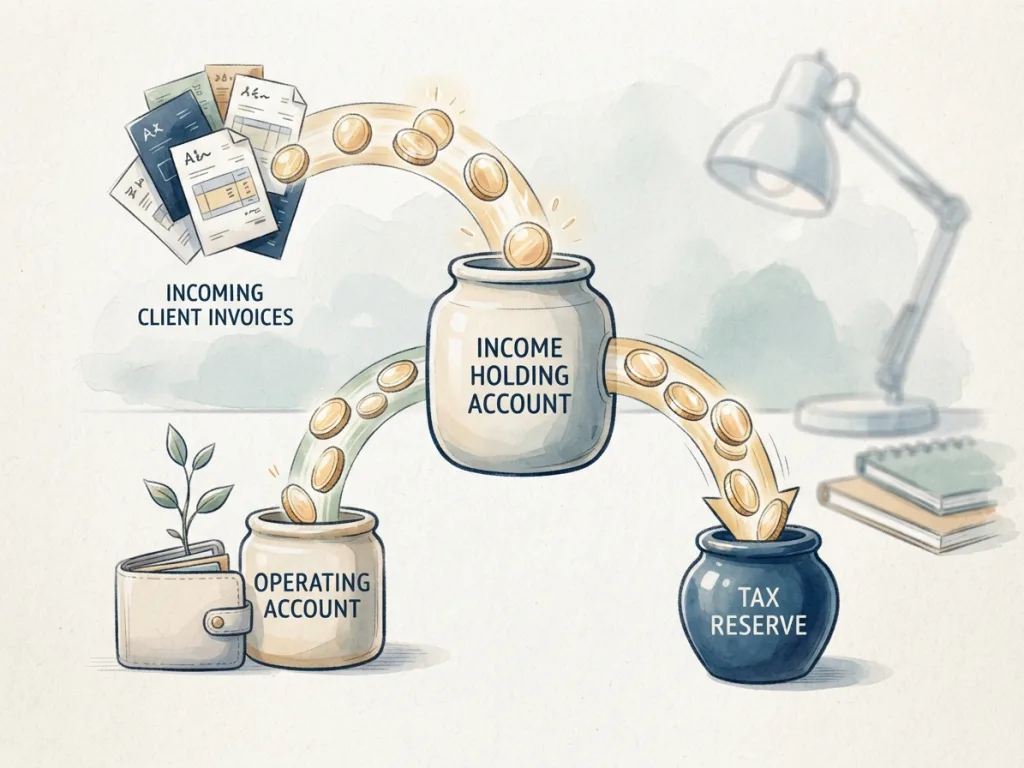
Instead of depositing client payments directly into your main checking account, direct all incoming payments into a dedicated business holding account. On a specific day of the month (for instance, the 1st of every month), transfer a predetermined fixed sum—your base "salary" calculated from your baseline budget—into your personal operating account.
This structure decouples your spending habits from invoice settlement dates, creating an artificial paycheck that remains identical every single month regardless of seasonal earnings volatility.
Step 3: Apply the Tiered Priority Allocation Strategy
When money lands in your holding account, allocate every dollar intentionally using a prioritized, zero-based workflow before spending begins.
| Allocation Tier | Target Purpose | Example Categories |
|---|---|---|
| Rule 0 (Immediate) | Tax Reservation | Federal, state, or municipal estimated taxes (25%–30%) |
| Tier 1 | Survival Needs | Rent, utilities, basic groceries, minimum debt payments |
| Tier 2 | Sinking Funds & Goals | Annual software renewals, tax reserves, retirement savings |
| Tier 3 | Lifestyle & Fun | Dining out, travel, entertainment, non-essential upgrades |
Rule 0: Reserve Taxes Upfront
Self-employed individuals and contractors do not have taxes automatically withheld from paychecks. The moment an invoice payment settles in your holding account, immediately move 25% to 30% into a separate Tax Reserve Account. Treating tax withholdings as non-negotiable step zero prevents severe tax liabilities at year-end.
Tier 1: Essential Survival Baseline
Fund your bare-bones monthly budget expenses first. These expenses take total priority over all discretionary items or secondary financial targets.
Tier 2: Sinking Funds and Long-Term Goals
Once essential baseline expenses are fully funded, allocate funds toward sinking funds. Sinking funds are savings categories designed for predictable future obligations that occur non-monthly, such as annual software licensing, device replacements, professional insurance premiums, or long-term retirement accounts.
Tier 3: Capped Lifestyle and Discretionary Spending
Only after Tiers 1 and 2 are satisfied should remaining cash flow to discretionary categories, such as dining, entertainment, or home projects. In variable income budgeting, lifestyle spending is flexible—it expands moderately during prosperous periods and shrinks automatically during lean ones.
Step 4: Managing High-Income vs. Low-Income Months
Managing variable earnings requires distinct procedures depending on whether current cash flow exceeds or falls short of your baseline expectation.
High-Month Protocol: Surplus Allocation
When client projects align and monthly income significantly exceeds your baseline salary requirement, treat the extra income as resource reserves for future months rather than general spending money:
- Top off the Income Buffer: Direct excess funds into your buffer account until you hold 1 to 3 full months of baseline spending expenses in reserve.
- Fund Sinking Categories: Pay ahead on known non-monthly expenses (like annual insurance or tax estimates).
- Accelerate Financial Goals: Allocate leftover surplus toward extra debt paydown or long-term investments.
- Cap Discretionary Bonuses: Allow yourself a small, predetermined reward percentage (e.g., 10% of surplus) for personal enjoyment while preserving the rest.
Low-Month Protocol: Drawing Safely from Your Buffer
When invoice volume dips or contracts pause, do not panic or resort to credit card debt. Transfer money directly from your Income Buffer Account into your operating checking account to cover the shortfall up to your fixed baseline salary level. Because you set money aside during high months, your monthly living standard and bill payment dates remain completely unchanged.
Step 5: Track Cash Flow and Multi-Account Reserves Efficiently
Executing a variable income strategy requires clearVisibility over where your money lives. Trying to manage separate tax reserves, buffer funds, and baseline budgets inside a single balance quickly leads to confusion.
To maintain control without spending hours on complex manual bookkeeping, use dedicated financial tools to organize your workflow:
- Organize Multiple Accounts: Set up and track explicit virtual balances—such as "Tax Holding Account," "Income Buffer," and "Daily Operating Account"—in personal tracking tools like MyMoney. Segregating money across distinct account balances eliminates the illusion that reserved tax cash is available for lifestyle spending.
- Establish Expense Baselines: Review historical monthly expense figures using built-in Budgets and Reports. Seeing spending patterns over 6 to 12 months makes it simple to establish an realistic baseline income floor.
- Log Invoices and Receipts Quickly: Freelancers on the move often miss minor deductions or forget variable cash expenses. Tools like AI Quick Entry prepare transaction drafts from natural language notes, and AI Receipt Scanner extracts paper receipt details into an editable review flow, ensuring you confirm every category before saving.
- Maintain Offline Access: Reliable financial tracking should work wherever you are working. With Offline-first tracking and sync, you can review current account balances and capture tax expenses regardless of whether you have an active network connection.
Common Variable Income Budgeting Pitfalls to Avoid
Even structured budgets fail if common operational mistakes go uncorrected:
- Confusing Buffer Funds with Emergency Savings: An Income Buffer Fund smooths out regular, predictable revenue fluctuations. An Emergency Fund is strictly reserved for unforeseen catastrophic events, like major health issues or sudden equipment destruction. Mixing these funds leaves you exposed during genuine crisis situations.
- Treating Surplus Earnings as Free Cash: Spending every dollar earned during peak months forces you into high-stress emergency modes during inevitable quiet months. Surplus cash belongs to future months and tax obligations.
- Postponing Tax Calculations: Waiting until annual filing deadlines to compute self-employment taxes leads to expensive penalties and sudden cash flow crises. Always deduct estimated tax percentages immediately upon receipt.
Frequently Asked Questions
What if my earnings drop below my baseline floor?
If your earnings drop below your floor for multiple consecutive months and your buffer account becomes depleted, immediately switch to your bare-bones survival budget. Trim non-essential Tier 3 expenses entirely and reduce discretionary sinking funds until client revenue recovers or new contracts begin.
How much tax should freelancers set aside each month?
While exact requirements depend on local tax jurisdictions, self-employed workers typically set aside between 25% and 30% of gross earnings to cover income tax and self-employment taxes. Consult a local tax professional to determine the exact percentage appropriate for your tax bracket.
Should I use an average monthly income figure instead of the floor?
Using an average monthly income figure carries higher risk. If your monthly revenue fluctuates dramatically (e.g., $8,000 in peak months and $2,000 in slow months), an average figure might suggest a $5,000 baseline. If you experience two consecutive $2,000 months, you will face severe cash shortages. Planning around your lowest earning month provides maximum stability.
Take Control of Your Variable Cash Flow
Budgeting with irregular income does not require predictable earnings; it requires a predictable process. By identifying your baseline income floor, establishing a dedicated income holding buffer, setting aside taxes immediately, and following a strict priority allocation model, you can eliminate the financial anxiety of variable income. You gain full control over your money—turning seasonal income peaks into long-term financial stability.