
Why People Stop Tracking Expenses (and How to Fix Your System)
Struggling to keep up with your money tracking routine? Discover the real psychological reasons why people stop tracking expenses and how to build a low-friction system that actually lasts.

It usually starts with strong intentions. You open a new spreadsheet or download a personal finance app, determined to log every dollar. For a week or two, everything goes according to plan. But then life gets busy. A few days pass without logging a single transaction, receipts begin piling up in your wallet or inbox, and opening the app starts to provoke a subtle sense of dread. Before long, the habit is quietly abandoned.
If this pattern sounds familiar, you are not alone. When exploring why people stop tracking expenses, the instinct is often to blame a lack of self-discipline or personal commitment. However, behavioral science suggests otherwise: habit failure is rarely a failure of willpower. Instead, it is almost always the result of bad system design, excessive entry friction, and emotional exhaustion.
Understanding why traditional methods fail is the first step toward building a financial tracking routine that effortlessly fits into your daily life.
The Psychology of Abandonment: Why Willpower Isn't the Problem
Willpower is a finite resource. Every decision you make throughout the day—from responding to work emails to deciding what to cook for dinner—depletes your mental energy. Expecting yourself to perform complex administrative tasks at the end of a exhausting day is a setup for failure.

Decision Fatigue and Daily Micro-Friction
Behavioral economists frequently highlight the concept of decision fatigue. When a tracking tool requires you to open an app, navigate multiple sub-menus, select a precise account, choose from dozens of subcategories, and manually type in amounts for minor purchases like a morning coffee, the cumulative friction becomes overwhelming.
During high-energy moments, this micro-friction seems negligible. But when your energy dips, even a five-click process feels like an insurmountable chore. When friction exceeds your immediate motivation, the habit collapses.
The Ostrich Effect and Emotional Avoidance
Another major reason people abandon expense tracking is psychological self-protection. In behavioral finance, the Ostrich Effect describes the tendency to avoid financial information when expecting negative feedback.
If you suspect you overspent during the weekend, opening a traditional finance app that displays bright red alerts or punitive messages can trigger guilt and anxiety. Rather than confronting the numbers, your brain naturally seeks to protect your mood by ignoring the app entirely.
Present Bias vs. Abstract Future Goals
Human decision-making favors immediate rewards over long-term benefits—a tendency known as present bias. The friction of logging an expense happens in the present moment, while the payoff—achieving a financial milestone months or years down the line—feels distant and abstract. When the daily effort outweighs the immediate psychological reward, consistency declines rapidly.
Systemic Flaws in Traditional Expense Tracking
Beyond psychology, many traditional tracking frameworks suffer from structural design flaws that actively undermine habit formation.
Over-Categorization Paralysis
Many budgeting guides advise breaking expenses down into hyper-specific micro-categories, such as splitting a grocery bill into Groceries: Produce, Groceries: Dairy, and Household Items. While detailed precision sounds productive on paper, it quickly creates categorization paralysis.
When you stand at a transaction screen wondering whether a quick lunch counts as "Dining Out," "Socializing," or "Work Expense," the mental overhead increases. Precision is not the same as accuracy; capturing broad spending patterns is far more important than accounting for every cent across thirty distinct categories.
Form-Heavy Mobile Interfaces
Many tracking apps are built like desktop accounting software squeezed onto a small phone screen. Requiring users to fill out multiple form fields, select dates from pop-up pickers, and manually assign tags on a mobile interface introduces unnecessary delay. Mobile tracking should be instantaneous, matching the fast pace of modern transactions.
Comparing Traditional vs. Low-Friction Tracking Workflows
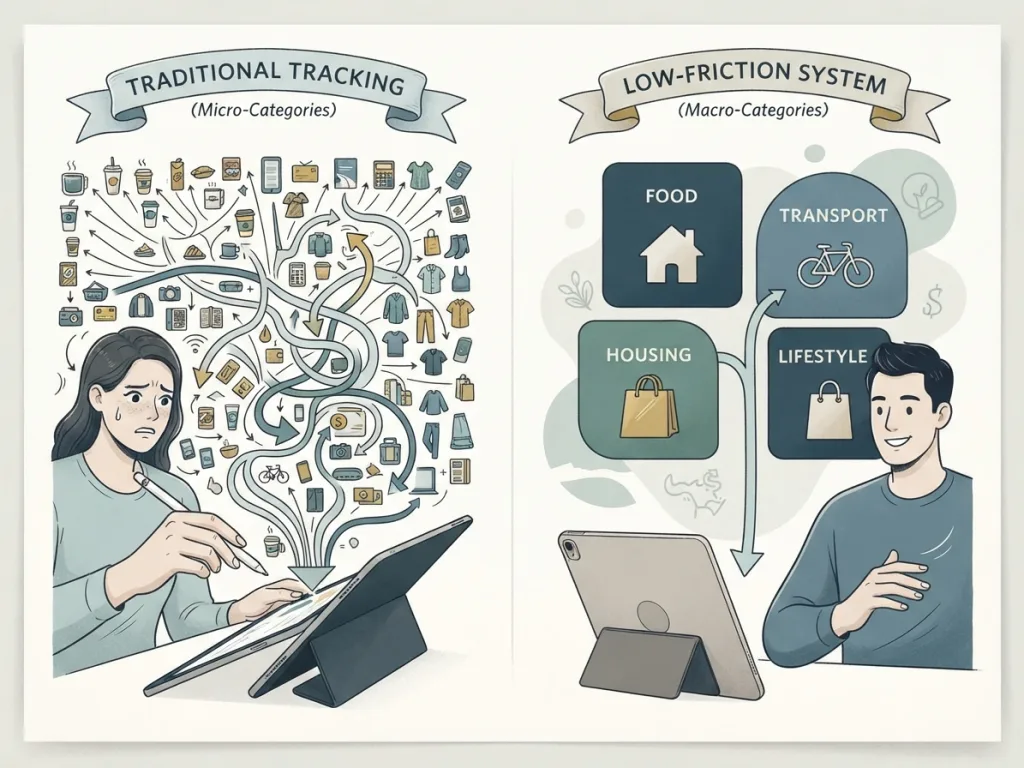
| Dimension | Traditional High-Friction Tracking | Modern Low-Friction Tracking |
|---|---|---|
| Data Entry Method | Manual multi-field forms and deep drop-down menus | Natural text input, voice dictation, or receipt scanning |
| Category Structure | 30+ micro-categories (e.g., "Groceries: Dairy") | Broad macro-categories (e.g., "Food", "Bills", "Flex") |
| Missed Days Protocol | Agonizing back-logging of missing receipts | Account balance calibration & fresh-start reset |
| Psychological Cue | Punitive overspending alerts and guilt | Neutral visibility into cash flow and insights |
| App Accessibility | Requires steady network connection to load screens | Offline-first logging with seamless background sync |
The Backlog Burden: Breaking the Catch-Up Cycle
One of the most destructive traps in money management is the "backlog burden." It usually follows a predictable sequence:
- You miss logging transactions for three or four days due to a busy schedule.
- A backlog of dozens of unlogged purchases builds up.
- The thought of sifting through credit card statements and physical receipts creates intense anxiety.
- You tell yourself you will catch up "this weekend."
- The task becomes too daunting, leading to total abandonment of the routine.
Why Missing Three Days Causes Total Quitting
When you miss several days of tracking, the effort required to update your records grows exponentially. What was once a ten-second daily task turns into a half-hour accounting audit. At this point, many people fall victim to the "fresh start fallacy"—believing that because their current record is incomplete, the entire month is ruined, so they might as well stop tracking until next month or next year.
The Power of the Fresh-Start Reset
To build a lasting habit, you must abandon the requirement for total retrospective perfection. If you fall behind by a week, do not spend hours digging through old receipts. Instead, execute a fresh-start reset:
- Re-calibrate your current account balances to reflect reality today.
- Forgive the unlogged gap period.
- Resume tracking today's purchases immediately.
Maintaining forward momentum and spending awareness is infinitely more valuable than maintaining an unbroken historical archive at the expense of your sanity.
Practical Strategies for a Low-Friction Tracking Habit
Building a successful financial routine requires minimizing physical and cognitive friction. Here is how you can streamline your system for long-term consistency.
1. Shift to Macro-Budgeting
Simplify your categories down to five to seven high-level macro-groups. For instance, combine dining, groceries, and coffee shops into a single "Food" category. Broad categories eliminate decision fatigue while still giving you clear visibility into where your money goes.
2. Leverage Multi-Modal Input Systems
Modern tools can drastically reduce entry effort by allowing flexible ways to capture data based on your immediate context:
- Natural Language Text: Instead of filling out three fields, quickly type standard phrases like "15 lunch" or "45 groceries". Advanced options like MyMoney use natural language drafting engines (such as AI Quick Entry) to parse your note into an editable transaction ready for quick confirmation.
- Voice Dictation: When walking back from a purchase, use your phone keyboard's voice-to-text functionality to speak your transaction naturally, letting the app draft the details hands-free.
- Receipt Scanning: For large store receipts with multiple items, scanning the physical receipt extracts entry details into an editable review screen, keeping you in complete control without manual typing.
3. Keep Human Control in the Loop
While automation speeds up data entry, completely autonomous financial tracking can paradoxically weaken your money awareness. When software acts silently in the background without your involvement, you lose active visibility over your spending habits.
The optimal approach combines automated assistance with human review. By using smart tools to prepare transaction drafts—whether from natural text, voice, or scanned receipts—you maintain total financial control simply by performing a quick final review and confirmation.
Frequently Asked Questions
Is it necessary to track every single penny to manage money effectively?
No. Aiming for absolute penny-perfect accuracy often leads to burnout. Capturing 80% to 90% of your primary financial transactions using broad categories provides more than enough data to make informed financial decisions and build lasting money habits.
What should I do if I fall behind on tracking expenses for a week?
Do not waste energy retroactively logging every missing purchase. Simply balance your current account totals, forgive the unlogged gap, and start fresh from today's expenses. Forward-looking awareness is much more important than complete historical perfection.
How can I track expenses without spending too much time every day?
To minimize time expenditure, simplify your category list to basic macro-groups and leverage modern multi-modal entry methods—such as voice dictation, natural text entry, or receipt scanning. An effective tracking routine should take only a few seconds per entry.
Conclusion: Make Tracking Work for You, Not Against You
If you have struggled to keep up with financial tracking in the past, remember that the problem was not your self-discipline—it was the friction embedded in your system. By lowering entry effort, avoiding hyper-detailed categories, and releasing the burden of back-logging missed days, you can create a sustainable habit that delivers clarity without stress.
Ready to experience effortless expense tracking? Discover how smart natural language entry, voice dictation, and receipt scanning can simplify your routine by exploring MyMoney today.